
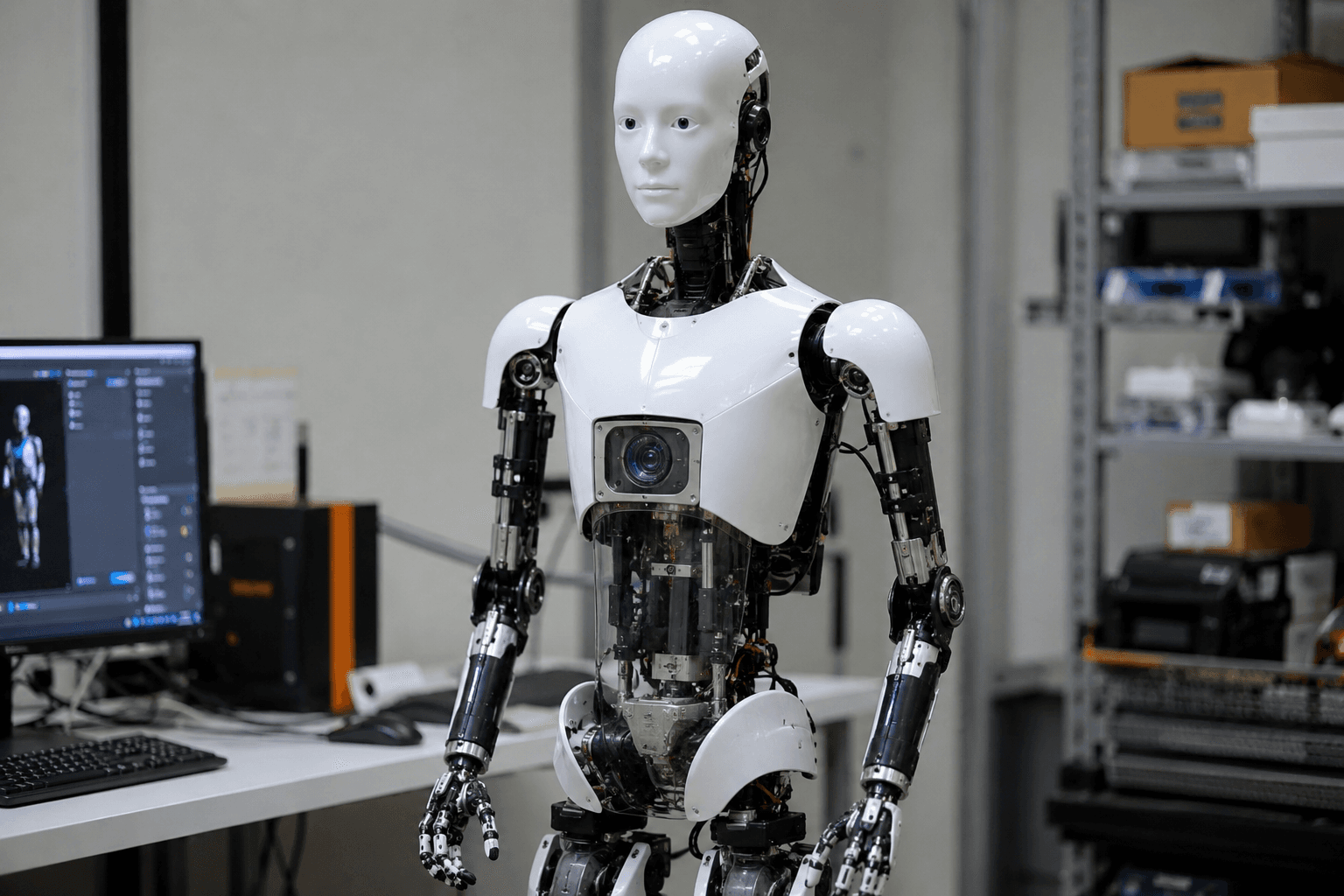
The three categories at a glance
"Humanoid robot" describes the shape: roughly human form, two legs, two arms. "AI robot" describes the brain: any robot whose behaviour comes from learned models rather than fixed scripts. "Service robot" describes the deployment: any robot that operates in environments shared with people. The categories overlap. A humanoid that runs a vision-language-action model and is deployed in a hotel lobby is all three.
Where humanoids fit
Humanoids are a subcategory of AI robots, almost always. The notable platforms in 2026 (Atlas, Optimus, Figure 02) all run learned policies for at least part of their behaviour stack. They're often deployed as service robots too (Figure at BMW, Digit at Amazon), but the humanoid form factor is the constant.
AI robots: the broader category
Plenty of AI robots don't look human at all. Quadrupeds like Spot or ANYmal use learned locomotion. Wheeled mobile manipulators in warehouses use learned grasping. Even surgical robots are increasingly using ML for tissue recognition. "AI robot" is the broadest term, and the least useful as a buying category. It tells you nothing about the form factor or the deployment.
Service robots: defined by where they work
The service-robot label is about deployment context: shared with people. Cleaning robots, hospitality runners, delivery bots, hospital telepresence platforms. They can be humanoid, wheeled, tracked, anything. What unites them is that they share floors with humans, which raises the bar on safety, predictability and human-readable signalling.
When you read "service robot" in a vendor pitch, ask: does this thing operate where humans walk? If yes, it's a service robot. The form factor and the AI stack are separate questions.